

Medical Supply Check

Procedure-readiness coordination

Medical Supply Check — hospital procedure readiness

Detect missing supplies earlier. Make follow-through accountable.

Identify shortages before the case, assign an owner and deadline, and verify resolution. Help teams improve procedure readiness without replacing their existing systems.

Assessment: six questions, immediate gaps and next steps. No account or email.

Readiness depends on recorded requirements, inventory and the last update. Stale data can falsely show ready. Verify current physical stock.

Clinicians reviewing procedure readiness together on a tablet

Shortage → owner → resolution

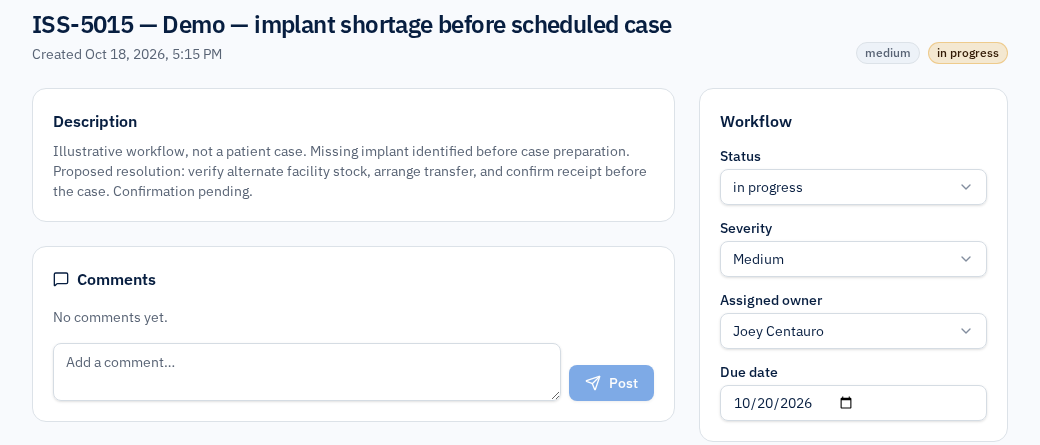
Real screen · illustrative issue, not patient data

Implant shortage · confirmation pending

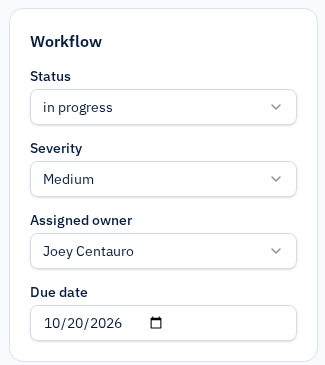
Close-up from the real issue screen: status in progress, assigned owner Joey Centauro, due date October 20, 2026
Proposed resolution: verify alternate stock, arrange a transfer and confirm receipt before the case. A workflow status is not proof of current stock.

Detect → Alert → Assign → Resolve → Confirm

Detect

Compare procedure requirements to recorded inventory.

Alert

Surface at-risk procedures before the day of surgery.

Assign

Route shortages to the right supply-chain owner.

Resolve

Transfer, substitute, or expedite missing items.

Confirm

Verify receipt and refresh inventory before reviewing readiness.

Works alongside your existing EHR, ERP and inventory systems — no integration required to start.

Readiness depends on recorded requirements, inventory and the last update. Stale stock data can incorrectly show a procedure as ready. Your team must verify current physical stock; Medical Supply Check does not replace clinical checks.

Beyond a shortage alert

Coordinate ownership. Intervene early. Start small.

Cross-department coordination

A missing item needs more than an alert. Coordinate across clinical and supply-chain teams with an assigned issue owner, a deadline, a proposed resolution recorded in the discussion, and a resolution status your team can check.

Owner · Deadline · Proposed resolution · Confirmation

Early warning before procedures

Review upcoming cases by readiness and scheduled time, alongside issue severity and request urgency. Focus intervention on critical shortages and approaching procedures before the missing supplies become a day-of-case surprise.

Readiness · Timing · Urgency

A low-friction starting point

Evaluate Medical Supply Check with a limited set of procedure templates and inventory verified by your team. Manual entry and CSV uploads let you start without an enterprise integration project or replacing your existing systems.

Limited scope · Verified data · No integration prerequisite

Readiness depends on recorded requirements, inventory and the last update. Stale stock data can incorrectly show a procedure as ready. Your team must verify current physical stock; Medical Supply Check does not replace clinical checks.

Start with the data you have

How it works without integration

Start with a limited set of procedure templates and team-verified inventory—using manual setup and CSV uploads, without connecting your EHR or ERP. Medical Supply Check uses the records you enter, not an automatic feed from systems you haven’t connected.

01

Choose a limited scope

Start with a small set of procedure templates. List the supplies and quantities they require, then add the upcoming cases and facilities in your evaluation.

02

Verify your starting inventory

Enter stock manually or use CSV templates. Preview and correct uploads, then have your team verify quantities, reservations and expiration dates against actual stock. Import validation alone does not verify physical inventory.

03

Work the shortages

Compare procedure requirements with recorded stock. Create supply requests and issues, assign owners, track progress and route substitutions for clinical approval.

Your team owns the refresh

Assign an owner to keep stock and procedure records current. CSV uploads do not schedule background synchronization. Readiness is only as current as your last update, and Medical Supply Check does not write back to your EHR or ERP without a separately implemented connection. Import templates and validation rules determine whether an upload adds or updates records.

Readiness depends on recorded requirements, inventory and the last update. Stale stock data can incorrectly show a procedure as ready. Your team must verify current physical stock; Medical Supply Check does not replace clinical checks.

One workflow. Three perspectives.

Built for the people coordinating procedure readiness.

Operating room director reviewing the day's surgery schedule on a large display

OR directors

Know which cases need attention.

  • Review upcoming procedure readiness by facility and date
  • See short items and prioritize at-risk cases
  • Use readiness reports to focus operational discussions
Supply chain staff member checking labeled surgical supply bins in a hospital storage room

Supply-chain leaders

Turn shortages into owned actions.

  • Track inventory, expiration and vendor performance
  • Manage supply requests and vendor issues
  • Review cross-facility transfer recommendations
Operating room nurse preparing surgical instruments before a procedure

Clinical staff

Keep clinical decisions with clinicians.

  • Check the supplies required for upcoming procedures
  • Raise issues and coordinate through comments
  • Review and approve or reject proposed substitutions

Readiness depends on recorded requirements, inventory and the last update. Stale stock data can incorrectly show a procedure as ready. Your team must verify current physical stock; Medical Supply Check does not replace clinical checks.

Works alongside your existing systems

Start with manual entry or spreadsheet uploads. Connections to hospital systems are optional, separately scoped work—not a prerequisite to evaluate Medical Supply Check.

For IT and integration teams

A focused evaluation, not an enterprise rollout

Discuss a four-week readiness pilot

Proposed outline for discussion—not a committed offer. Scope, dates, support, fees and targets must be agreed with your hospital before starting.

Initial scope
One department at one facility, three to five procedure templates, selected upcoming cases and team-verified inventory. No system connection required.
Proposed timeline
Week 1: scope, baseline and data checks. Weeks 2–3: monitor selected cases and work shortages. Week 4: review evidence and decide next steps.
Proposed deliverables
A scoped template set, inventory verification log, shortage register with owners and deadlines, resolution records and an end-of-pilot summary.
Success criteria to agree
Measure warning lead time, owner/deadline coverage, resolutions confirmed before the case, inventory freshness and coordination time against the baseline. Set targets together; fewer delays are not guaranteed.

Readiness depends on recorded requirements, inventory and the last update. Stale stock data can incorrectly show a procedure as ready. Your team must verify current physical stock; Medical Supply Check does not replace clinical checks.

Discuss pilot scope

The value of readiness

What could fewer delays mean for your OR?

Model recovered operating-room time and staff coordination time using your own assumptions. All figures below are estimates, not measured Medical Supply Check results.

Readiness depends on recorded requirements, inventory and the last update. Stale stock data can incorrectly show a procedure as ready. Your team must verify current physical stock; Medical Supply Check does not replace clinical checks.

cases / month

minutes / case

USD / minute

staff minutes / case

Illustrative starting assumptions: 8 cases per month, 45 OR minutes and 30 staff minutes per case, at $40 per OR minute. The $40 value is an example, not a current national average. Count each case once; for cancellations, include only OR time that would otherwise go unused.

Modeled gross OR-time value / month

$14,400

Cases avoided × recovered OR minutes × cost per minute

Case disruptions avoided / month
8
OR hours recovered / month
6
Coordination hours saved / month
4
Modeled cost of one delay
$1,800

Recovered capacity is not guaranteed cash savings or additional revenue. This is not net ROI: subscription, implementation and other costs are excluded. Staff hours are reported separately and not added to OR-time value, avoiding double counting.

Published context: Childers & Maggard-Gibbons reported an average inpatient OR accounting cost of $37.45 per minute in California hospitals for fiscal year 2014. This historical, regional estimate is not a current national rate or marginal cash saving. Read the study · JAMA Surgery, 2018

Build the evidence with a pilot

A meaningful pilot compares supply-related delays and cancellations before and after Medical Supply Check, confirms recovered OR minutes, and records staff coordination time. No verified Medical Supply Check pilot outcomes are published here yet.

Discuss a pilot

Not ready to book a demo?

Take the OR supply readiness checklist to your next team huddle: procedure requirements, stock availability, clinical review and final handoff. One page. No email or account required.

Download OR readiness checklist (PDF)